- Scriptorium Initiative | Page Partner
You Can Clone the CEO. Can You Clone Credibility?
September 25, 2026



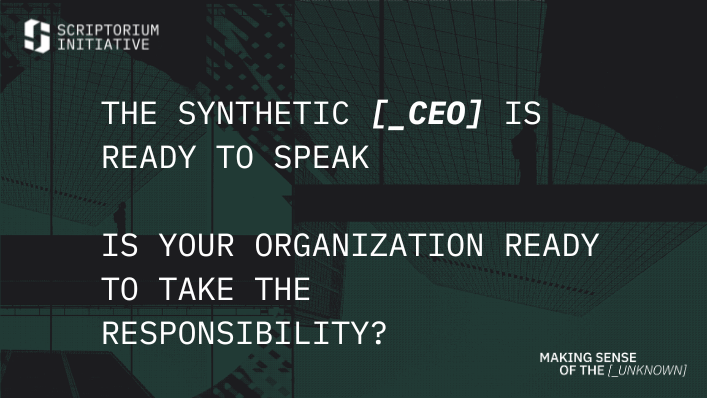
The Scriptorium Initiative in collaboration with Page Society
The Scriptorium Initiative’s new whitepaper explores a question that communications leaders will increasingly face: what happens when an organization can reproduce its CEO’s presence without requiring the CEO to appear?
The attraction is easy to understand. A synthetic executive can deliver approved messages across languages and markets, making leadership communication more accessible and consistent. For teams managing scarce executive time, that is a compelling proposition.
But a CEO’s face and voice carry more than a message. They carry authority. When employees hear their chief executive explain a decision, they may reasonably assume personal knowledge, endorsement and commitment. Reproducing the appearance of that commitment creates responsibilities that a disclosure label alone cannot resolve.
Our research with experienced communications professionals suggests a nuanced response. Participants did not automatically reject synthetic CEO communication. Their willingness to consider it depended on practical usefulness, perceived risk and context. Routine, approved communication was a more acceptable starting point. Crises, layoffs and major organizational change drew much greater resistance. These are findings from a bounded study, rather than proof of wider stakeholder acceptance.
For Chief Communications Officers, this puts a consequential decision on the agenda. Who decides what a synthetic representative may say? When must the real executive appear? And what happens when a representation moves from delivering a script to answering questions?
Our whitepaper introduces three practical frameworks to help organizations address those decisions: the Authority Test, the Human Minimum Standard and the Synthetic CEO Protocol.
At Scriptorium, we believe synthetic representation can extend leadership’s reach. Its value depends on preserving a clear connection between the person represented, the message delivered and the responsibility accepted.

The Scriptorium Initiative in collaboration with Page Society The global landscape of Artificial Int…

Corporate communications departments face growing pressure to automate routine administrative tasks …
Corporate affairs leaders face growing complexity as the United States and China redefine their comm…