- Research
The AI Paradox: Faster Work, Greater Risks and the 'Verification Tax'
November 17, 2026


As organizations race to embrace artificial intelligence, communicators are discovering unexpected consequences. There’s the “verification tax,” the time spent fact-checking AI-generated work that can erase promised productivity gains. There’s the “middle squeeze,” as mid-career professionals face growing pressure from employers who see AI-fluent graduates as a less expensive alternative. And there’s a troubling dilemma for the next generation: If AI handles the entry-level work, how will young communicators develop the judgment and skills they need to become tomorrow’s leaders?
The disruption doesn’t stop there. Some communications executives report cutting agency spending by 40% to 50%, while others are rethinking the skills they hire for and even bringing back old-fashioned writing tests to evaluate candidates without AI assistance. Senior leaders are experimenting with AI-powered “chiefs of staff,” even as they confront tools that invent facts, reinforce executive biases and introduce new security risks.
Meanwhile, the role of the communicator itself is evolving, from “messaging strategist” to “reach strategist,” as AI transforms how people discover information, engage with brands and make decisions.
These are among the revealing findings of new research from Ragan and the Arthur W. Page Society, based on seven groups with 21 senior communications executives in the United States, United Kingdom and China between March and May 2026. Interviewed by Page member and scholar Marlene Neil, Ph.D., APR, Fellow PRSA, their experiences paint a picture of a profession at a pivotal moment: AI is creating new efficiencies while challenging traditional career paths, team structures and the value of human expertise. The findings raise a critical question for every communications leader:
While research indicates that nearly 40% of standard tasks in the communication industry can be completed or accelerated with AI assistance, enterprise adoption across the corporate communications function remains predominantly in a “pilot, testing, or sandbox stage.” Most experimentation is driven by individual curiosity rather than broad, system-wide workflow integration.
Although 75% of communicators actively use generative AI tools, fewer than half have established formal, AI-enabled workflows. Senior executives face growing challenges around governance, technology integration, “shadow AI” security risks, and the imperative for continuous human oversight.
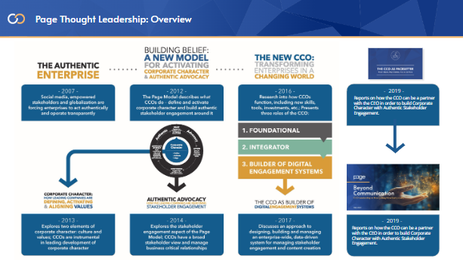
This brief summary is intended to cover the main points of the major thought leadership reports issu…
Page Society in collaboration with the Scriptorium Initiative Generative AI can write the copy, comp…